NEWYou can now listen to Fox News articles!
The Supreme Court handed President Donald Trump two major immigration victories on Thursday morning, both having to do with his administration’s efforts to reduce asylum claims.
In the first case, Mullin v. Al Otro Lado, the court held that migrants who are turned away at the border before entering the United States are not entitled to apply for asylum. In the second case, Mullin v. Doe, the court ruled that Haitian and Syrian nationals in the United States with Temporary Protected Status (TPS) could not receive judicial relief postponing the revocation of their status while they challenge the Trump administration’s efforts to revoke it in court.
Together, the rulings mark a shift in the legal fight over who can seek protection in the United States, giving the Trump administration a new avenue to limit asylum claims at the border and more leeway to move forward with ending temporary protections for certain migrants already in the country. The rulings also remove key legal obstacles to the administration’s broader push to reduce border crossings and accelerate removals.
Writing the opinion in Mullin v. Al Otro Lado, Justice Samuel Alito argued that a migrant who reaches the southern border but is turned away before entering has not, for legal purposes, “arrive[d] in” the United States. The holding is significant because current law provides that anyone who “arrives in the United States” has the right to apply for asylum.
SUPREME COURT STRIKES DOWN ‘VAMPIRE RULE’ IN MASSIVE SECOND AMENDMENT WIN
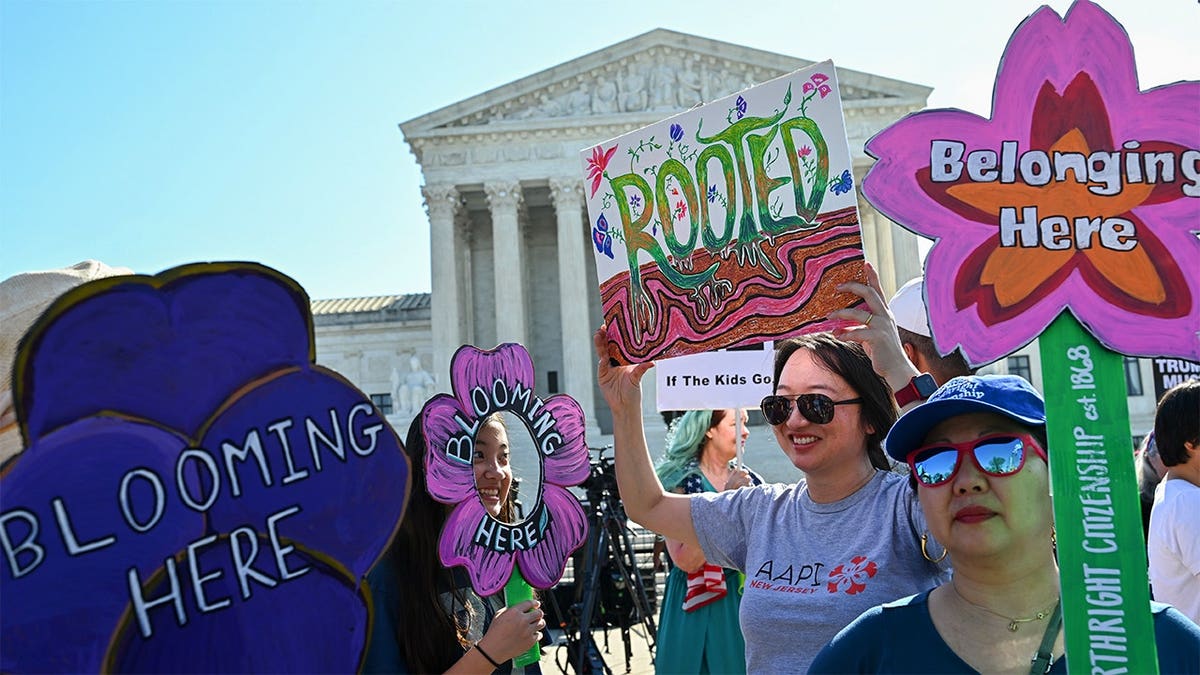
Demonstrators outside the Supreme Court in Washington, D.C., on Wednesday, April 1, 2026. ((Graeme Sloan/Bloomberg via Getty Images))
“This case presents a straightforward question: whether an alien who seeks to enter the United States from Mexico ‘arrives in the United States’ when he or she is still in Mexico,” Alito wrote. “In the decision below, the United States Court of Appeals for the Ninth Circuit answered ‘yes.’ That is wrong. In ordinary speech, no one would say that a person ‘arrives in’ a place — for example, a house, a city, or a country — before the person enters that place.”
Justice Sonia Sotomayor, who wrote the dissenting opinion for the case, did not see it as being so straightforward.
Joined by Justices Elena Kagan and Ketanji Jackson, Sotamyor argued that the majority’s rationale was overly simplistic and ignored other contexts where immigrants about to enter the United States are considered to be “arriving.”
“We had to go all the way to SCOTUS to vindicate the principle that an alien is not ‘in the United States’ until he is, in fact, in the United States. We have yet AGAIN been vindicated by the Supreme Court. This decision opens up an important tool to continue securing our southern border,” Department of Homeland Security General Counsel James Percival told Fox News Digital.
Also writing the opinion in Mullin v. Doe, Alito held that the law establishing TPS explicitly blocks recipients from legal relief unless their claims have a constitutional basis.
ALITO BLASTS LAWYER’S WORD-SALAD BLURRING ASYLUM LAW
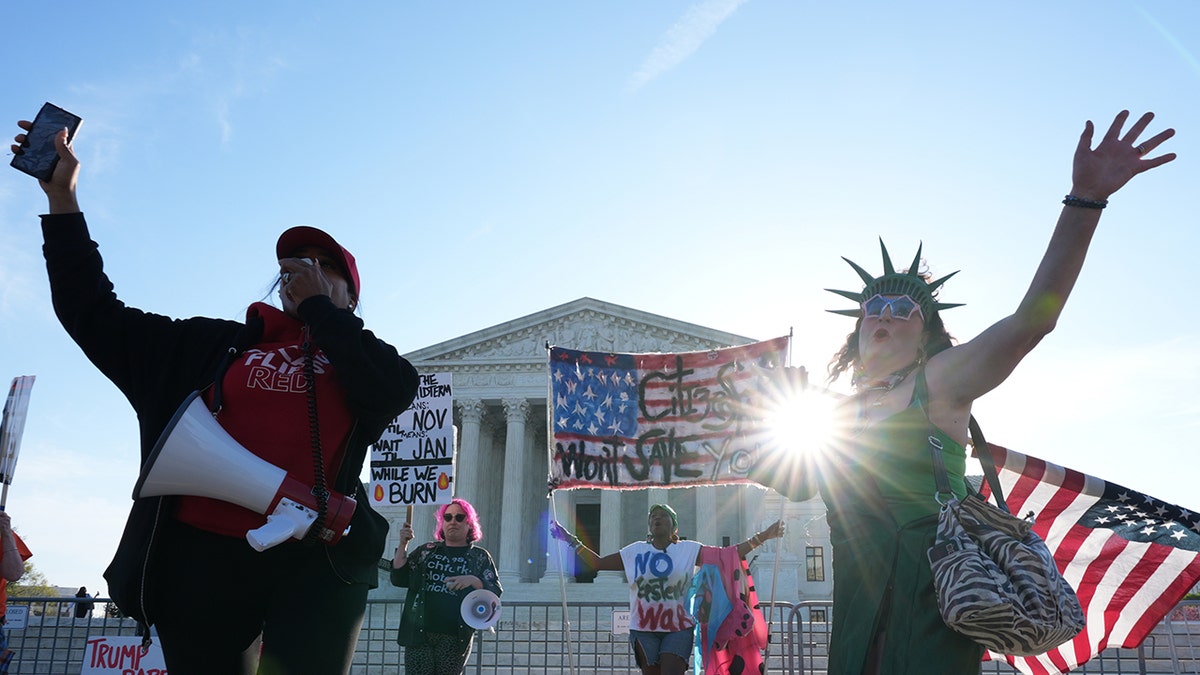
Pro and anti-Trump demonstrators rally outside the U.S. Supreme Court in Washington, D.C., on April 1, 2026, before justices hear oral arguments on whether President Donald Trump can deny citizenship to children born to parents who are in the United States illegally or temporarily. (J. Scott Applewhite/Associated Press)
“In these cases, we consider whether respondents, who challenge the termination of Temporary Protected Status (TPS) for aliens from Syria and Haiti, are entitled to orders postponing the terminations during litigation,” Alito wrote. “We hold that they are not.”
The dissenting justices, led by Elena Kagan, argued that the Haitian asylees may have a constitutional argument to block the revocation of their status. According to Kagan, there is evidence suggesting that the Trump administration was motivated by “racial animus” when it decided to revoke TPS for Haitians.
To support this argument, she cites statements the president made about Haitians in the lead-up to the 2024 election, including claims that they were eating pets in Ohio, as well as other remarks he has made about migrants of African descent. If race was a factor in denying TPS status to Haitians, they could argue that their constitutional right to equal protection under the law was being violated, enabling lower courts to shield them from deportation pending litigation.
Kagan also took issue with the revocation on procedural grounds, arguing that the Department of Homeland Security failed to take the steps required under the law to revoke TPS status for Haitians and Syrians.
SCOTUS TO REVIEW TRUMP EXECUTIVE ORDER ON BIRTHRIGHT CITIZENSHIP
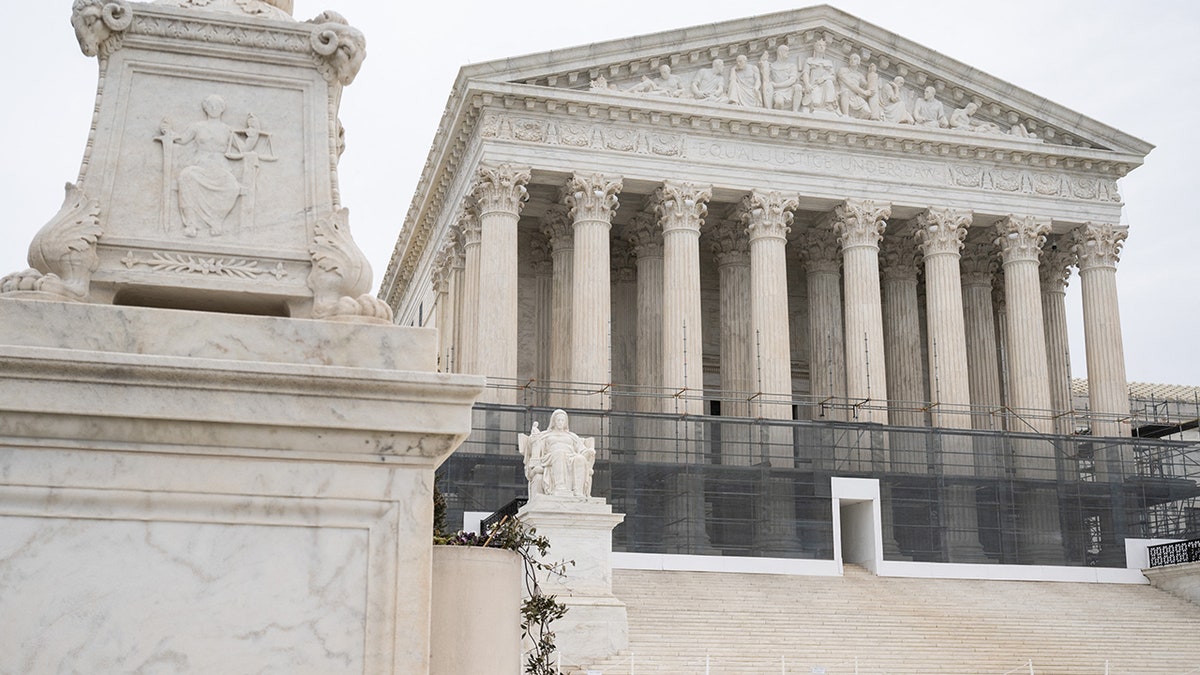
The U.S. Supreme Court building is shown in Washington, D.C., on Jan. 9, 2026. The court did not issue a ruling on President Donald Trump’s global tariffs on that day. (Saul Loeb/AFP via Getty Images)
“The TPS statute plainly bars consideration of respondents’ non-constitutional claims. It allows ‘no judicial review of any determination . . . with respect to the . . . termination’ of a TPS designation,” Alito continued.
Alito added that a racial explanation for the change is unlikely to be proven, given that the respondents themselves suggested that the Trump administration may simply oppose TPS as a point of policy, without respect to any particular group.
“In our second Supreme Court win of the day, the Court vindicates DHS yet again. The T in TPS stands for TEMPORARY, yet many of these designations became de facto amnesty. This is a win for the rule of law and common sense,” Percival continued.
CLICK HERE TO DOWNLOAD THE FOX NEWS APP
Both TPS and court rulings recognizing asylum-processing rights for migrants stopped just outside U.S. ports of entry had become flashpoints for conservatives, with immigration hawks arguing they facilitated abuse.
By making asylum applications more difficult and green-lighting the termination of Temporary Protected Status for some people already in the country, the Supreme Court’s decisions give the Trump administration an advantage in its effort to reduce asylum claims.